TL;DR
- US merchants paid 187.20 billion dollars in card processing fees in 2024, according to The Nilson Report.
- The networks that set those fees revise them twice a year, and merchants now absorb about half of all debit card fraud losses.
- Every figure here is sourced to a named outside source, grouped by theme, with its year.
Short answer
Payment fees are large, rising, and increasingly the merchant's problem to catch. US merchants paid 187.20 billion dollars in card processing fees in 2024, the networks that set those fees revise them twice a year, and merchants now absorb about half of all debit card fraud losses. These are the credible third-party numbers behind that picture, grouped by theme, each with its named source and year. They make the case for checking what a payment provider charged you, rather than assuming it was right.
Every statistic comes from a named outside source, not from Bluefyn. Where a number is from vendor-commissioned or paywalled research, that is stated next to it.
Key takeaways
- US merchants paid 187.20 billion dollars in card processing fees in 2024 (The Nilson Report).
- Merchants absorbed 49.9 percent of US debit card fraud losses in 2023, up from 38.3 percent in 2011 (Federal Reserve).
- Global chargeback dollar losses are projected to rise from 33.8 billion dollars in 2025 to 41.7 billion in 2028 (Mastercard).
- Interchange and network fee schedules are revised on a standing twice-a-year cadence.
- 36 percent of companies lose at least a full workday a week to reconciliation (Forrester study, vendor-commissioned).
The size of the problem
Global card fraud losses reached 33.41 billion dollars in 2024, down 1.2 percent from 33.83 billion in 2023, against 51.92 trillion dollars in total global card volume, according to The Nilson Report (2026 release, 2024 data).
US merchants absorbed 49.9 percent of debit card fraud losses in 2023, up from 46.9 percent in 2021 and 38.3 percent in 2011, while the banks' share fell from 59.8 percent in 2011 to 28.3 percent in 2023, per the Federal Reserve's biennial Regulation II report (2023 data, published 2025). The cost of getting payments wrong has been shifting steadily onto merchants.
Fraud losses as a share of debit transaction value more than doubled in a decade, reaching 17.6 basis points in 2023, or 17.63 dollars per 10,000 dollars of value, up from 7.8 basis points in 2011 (Federal Reserve).
Global chargeback dollar losses are projected to grow from 33.8 billion dollars in 2025 to 41.7 billion in 2028, a structural cost line separate from fraud losses, according to Mastercard's 2025 State of Chargebacks Report.
Interchange and processing fees
US merchants paid 187.20 billion dollars in total card processing fees in 2024, made up of 148.52 billion on credit cards, up 9.3 percent from 2023, plus 38.68 billion on debit and prepaid cards, according to The Nilson Report (2025).
US debit and prepaid interchange fees totaled 34.12 billion dollars in 2023, growing an average of 3.9 percent per year since 2021 (Federal Reserve).
The average interchange fee on a covered debit transaction was 0.24 dollars on single-message networks and 0.22 dollars on dual-message networks in 2023 (Federal Reserve). Small per-transaction numbers become large ones at volume.
US payment card networks processed 100.7 billion debit and prepaid transactions worth 4.7 trillion dollars in 2023 (Federal Reserve). That is the base every per-transaction fee is applied against.
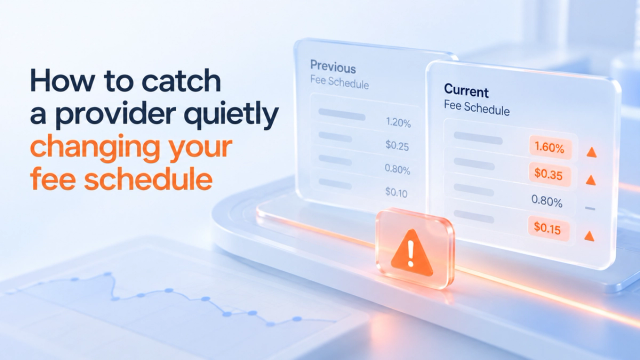
Interchange and network fee schedules are revised on a standing twice-a-year cadence, in April and October. This is a widely corroborated operational fact across payments-industry sources rather than a single published figure, but it means the terms behind your fees change at least twice a year, whether or not you notice.
Chargebacks and disputes
Global chargeback volume is projected to rise from 261 million in 2025 to 324 million in 2028, a 24 percent increase in three years, according to Mastercard's 2025 State of Chargebacks Report.
About 63 percent of merchant transactions are now digital, or card-not-present, which Mastercard's report names as a primary driver of rising disputes, since card-not-present transactions dispute at higher rates than in-person ones.
Friendly fraud is projected to rise from 22 percent of all chargebacks in 2026 to 28 percent by 2031, with its dollar value growing from 8.1 billion dollars in 2026 to nearly 16 billion in 2031, a 96 percent increase, according to Juniper Research (2026).
The cost of manual reconciliation
36 percent of companies lose at least one full workday a week to financial reconciliation, according to a Forrester Consulting study, though that study was commissioned by a payments provider, so treat it as vendor-sponsored research rather than independent.
Top-performing accounts-payable teams run a 9 percent invoice exception rate, against roughly one in five invoices needing manual handling across the industry, per Ardent Partners benchmarking. The precise industry average is reported inconsistently across secondary citations, so the safe figure is roughly one in five.
49 percent of organizations still manually key invoice data into their accounting system, according to a 2024 Levvel Research report. Manual handling is where errors enter, and where a wrong charge slips through unchecked.
Hidden and incorrect charges
About 39 percent of manually processed invoices contain at least one error, a figure attributed to the Institute of Finance and Management. Public, payments-specific data on incorrect provider charges is genuinely thin, which is part of the point: the errors are common but rarely measured, because most are never checked.
Independent numbers on what share of merchants overpay, or by how much, do not hold up to sourcing. The widely repeated claims that merchants overpay by some large percentage, or that interchange makes up the bulk of processing fees, trace back to no verifiable study, so they are excluded. The honest state of the evidence is that the fees are large and rising, the terms change constantly, and almost nobody checks each charge against the contract that priced it.
Why these numbers matter
Read together, the credible figures tell one story. The fees are large and growing. The terms behind them change at least twice a year. Merchants carry a rising share of the cost. And the checking of individual charges, where an error would actually be caught, is still mostly manual or skipped. A wrong charge does not announce itself. It sits inside a monthly total that reconciles fine at the summary level.
That is the job Bluefyn is built for. Bluefyn reconstructs the contract into an expected charge for every transaction, compares it to what was actually charged, and flags the ones that do not match. It analyzes transaction and provider data. It never moves, holds, or custodies funds. These numbers are the reason the check is worth running. For how the check works in practice, see how a signed contract becomes a per-transaction check and how to detect fee leakage.
Frequently asked questions
How much do US merchants pay in card processing fees?
US merchants paid 187.20 billion dollars in total card processing fees in 2024, according to The Nilson Report: 148.52 billion on credit cards, up 9.3 percent from the year before, and 38.68 billion on debit and prepaid cards. Card processing fees are one of the largest controllable costs a payment business carries, which is why verifying them against the contract matters.
How often do interchange and network fees change?
The card networks revise their interchange and network fee schedules on a standing twice-a-year cadence, in April and October. This is a widely corroborated operational pattern across the payments industry. It means the terms that price your transactions change at least twice a year, so a rate that was correct last quarter can be wrong this quarter without any error on your side.
Are chargebacks getting more expensive?
Yes. Global chargeback dollar losses are projected to rise from 33.8 billion dollars in 2025 to 41.7 billion in 2028, and global chargeback volume from 261 million to 324 million over the same period, according to Mastercard's 2025 State of Chargebacks Report. Friendly fraud, where a genuine cardholder disputes a real charge, is a growing share of that, projected by Juniper Research to reach 28 percent of all chargebacks by 2031.
What share of debit card fraud do merchants pay for?
US merchants absorbed 49.9 percent of debit card fraud losses in 2023, up from 46.9 percent in 2021 and 38.3 percent in 2011, according to the Federal Reserve's biennial Regulation II report. Over the same period the banks' share fell from 59.8 percent to 28.3 percent. The cost of fraud has been shifting steadily onto merchants.
Is there reliable data on how much merchants are overcharged?
Not really, and that is worth being honest about. Widely repeated figures claiming merchants overpay by some large percentage, or that interchange makes up the bulk of processing fees, trace back to no verifiable source, and are excluded. What is well documented is that fees are large and rising, the terms change at least twice a year, and most individual charges are never checked against the contract. The gap between what is charged and what was agreed is real but rarely measured, because measuring it means verifying every transaction.